On this page
Jaundice is the yellow color the skin and the whites of the eyes take on when bilirubin builds up in the blood. Bilirubin is a yellow pigment that the liver normally processes and clears in the bile. When that pathway is disrupted, bilirubin rises, deposits in tissues and jaundice appears. It usually becomes visible once bilirubin exceeds 2 to 3 mg/dL (the normal value is below 1).
Jaundice is not a disease in itself but a sign that something is going wrong. It can be caused by a problem in the liver itself, by an obstruction of the bile ducts, or by the accelerated breakdown of red blood cells. This article explains why it happens, which signs accompany it, how newborn jaundice differs from jaundice in adults and, above all, when you should seek urgent care.
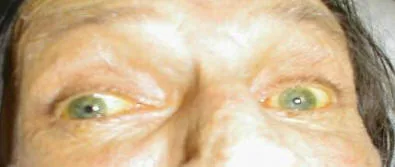
Why does the skin turn yellow?
Every day the body recycles old red blood cells. As they are broken down, bilirubin is produced, a yellow pigment that travels through the blood to the liver. There the liver cell transforms it to make it water-soluble (conjugated or direct bilirubin) and clears it in the bile, which passes into the intestine and gives stool its color.
Jaundice appears when this process is interrupted at some step and bilirubin builds up in the blood. Being a pigment, it stains tissues yellow. The whites of the eyes (the sclerae) are usually the first place it shows, because they are a pale tissue rich in elastin, which binds bilirubin well.
Causes of jaundice by mechanism
To understand the cause, it helps to think about which part of bilirubin’s journey is failing. There are three broad groups.
Prehepatic (before the liver): too much bilirubin
The liver is healthy but receives more bilirubin than it can process. This mainly occurs in hemolysis, the accelerated destruction of red blood cells (hemolytic anemias). Here indirect (unconjugated) bilirubin rises; it does not pass into the urine, so this jaundice is not accompanied by dark urine. Gilbert syndrome, a very common benign variant of bilirubin metabolism, causes mild elevations that increase with fasting, infections or stress and needs no treatment.
Hepatic (liver damage)
The problem is in the liver cell, which becomes inflamed or damaged and loses the ability to process and excrete bilirubin. Typical causes are:
- Acute viral hepatitis: hepatitis A, hepatitis B and hepatitis C.
- Damage from medications or toxins, such as acetaminophen toxicity or mushroom poisoning.
- Alcohol-related damage and autoimmune hepatitis.
- Advanced cirrhosis, in which jaundice appears late and reflects loss of function.
Obstructive or cholestatic (blockage of bile outflow)
Bile cannot leave the liver toward the intestine because the bile duct is blocked. The most common causes are stones in the bile duct, tumors of the pancreas or the bile ducts (such as cholangiocarcinoma), and cholestatic liver diseases such as primary biliary cholangitis and primary sclerosing cholangitis. In these cases direct (conjugated) bilirubin rises, along with alkaline phosphatase and GGT.
Signs that usually accompany jaundice
Jaundice rarely comes alone. The associated signs help point to the cause:
- Dark urine (choluria): urine the color of strong tea or cola. It appears when direct bilirubin rises, which is filtered by the kidney. It is often the first sign, before the skin turns yellow.
- Pale (acholic) stools: whitish or clay-colored stools. This happens when bile does not reach the intestine, typical of bile duct obstruction.
- Itching (pruritus): it can be intense, worsens at night and is characteristic of cholestatic causes.
The combination of jaundice, dark urine and pale stools strongly suggests a problem with bile outflow and always requires evaluation.
How is it evaluated?
Evaluation starts with a careful history and physical examination, followed by blood tests. The first step is to measure bilirubin and fractionate it into direct and indirect, together with the rest of the liver panel: liver enzymes, alkaline phosphatase, GGT, albumin and prothrombin time. That pattern points to whether the problem is prehepatic, hepatic or obstructive. When obstruction is suspected, the next step is usually an abdominal ultrasound to look at the liver and bile ducts.
Newborn jaundice is different
Jaundice in newborns is a different and very common situation: most newborns develop it in the first days of life. It is generally physiologic, because the baby’s liver is still immature at processing bilirubin, and it clears on its own within one or two weeks. Indirect bilirubin predominates, and it is not accompanied by dark urine or pale stools.
Even so, it needs monitoring. When bilirubin rises too high, it can damage the baby’s brain, a serious condition called kernicterus. For this reason pediatric guidelines recommend measuring bilirubin systematically and treating with phototherapy when it exceeds certain thresholds for the baby’s age in hours. Consult the pediatrician if jaundice appears in the first 24 hours of life, if the baby looks very yellow, sluggish or feeds poorly, or if jaundice lasts more than two weeks. In a newborn, pale stools and dark urine are never normal and require ruling out a bile duct obstruction (such as biliary atresia).
When to seek urgent care
Jaundice should always be evaluated by a doctor. Seek care immediately, or go to an emergency department, if jaundice is accompanied by:
- Fever and severe pain in the right upper abdomen, which may indicate an infection of the bile ducts.
- Confusion, drowsiness or disorientation, signs of hepatic encephalopathy.
- Very pale stools together with dark urine, which suggest bile duct obstruction.
- Vomiting blood or black stools.
- Sudden onset of intense jaundice, especially after taking acetaminophen, mushrooms or other toxins.
- Jaundice in a newborn during the first 24 hours of life.
In a person with no known liver disease, any new jaundice deserves prompt evaluation to find the cause and treat it in time.
See also
References
- Gondal B, Aronsohn A. A Systematic Approach to Patients with Jaundice. Semin Intervent Radiol. 2016;33(4):253-258.
- Sullivan JI, Rockey DC. Diagnosis and evaluation of hyperbilirubinemia. Curr Opin Gastroenterol. 2017;33(3):164-170.
- Kemper AR, et al. Clinical Practice Guideline Revision: Management of Hyperbilirubinemia in the Newborn Infant 35 or More Weeks of Gestation. Pediatrics. 2022;150(3):e2022058859.
- European Association for the Study of the Liver. EASL Clinical Practice Guidelines on genetic cholestatic liver diseases. J Hepatol. 2024;81(2):303-325.
Related articles
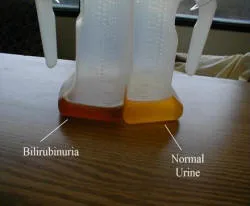
Dark urine (choluria): what it means and when to worry
Choluria is dark, tea- or cola-colored urine caused by bilirubin in the urine. It is often a sign of liver or bile duct disease. When to see a doctor.
Hepatic encephalopathy
Hepatic encephalopathy is a decline in brain function from toxins a diseased liver fails to clear. How to recognize it, what triggers it and how it is treated.
Itching (pruritus) in liver disease
Itching, or pruritus, is a common and sometimes intolerable symptom of cholestatic liver diseases. Why it happens and how it is treated step by step.