On this page
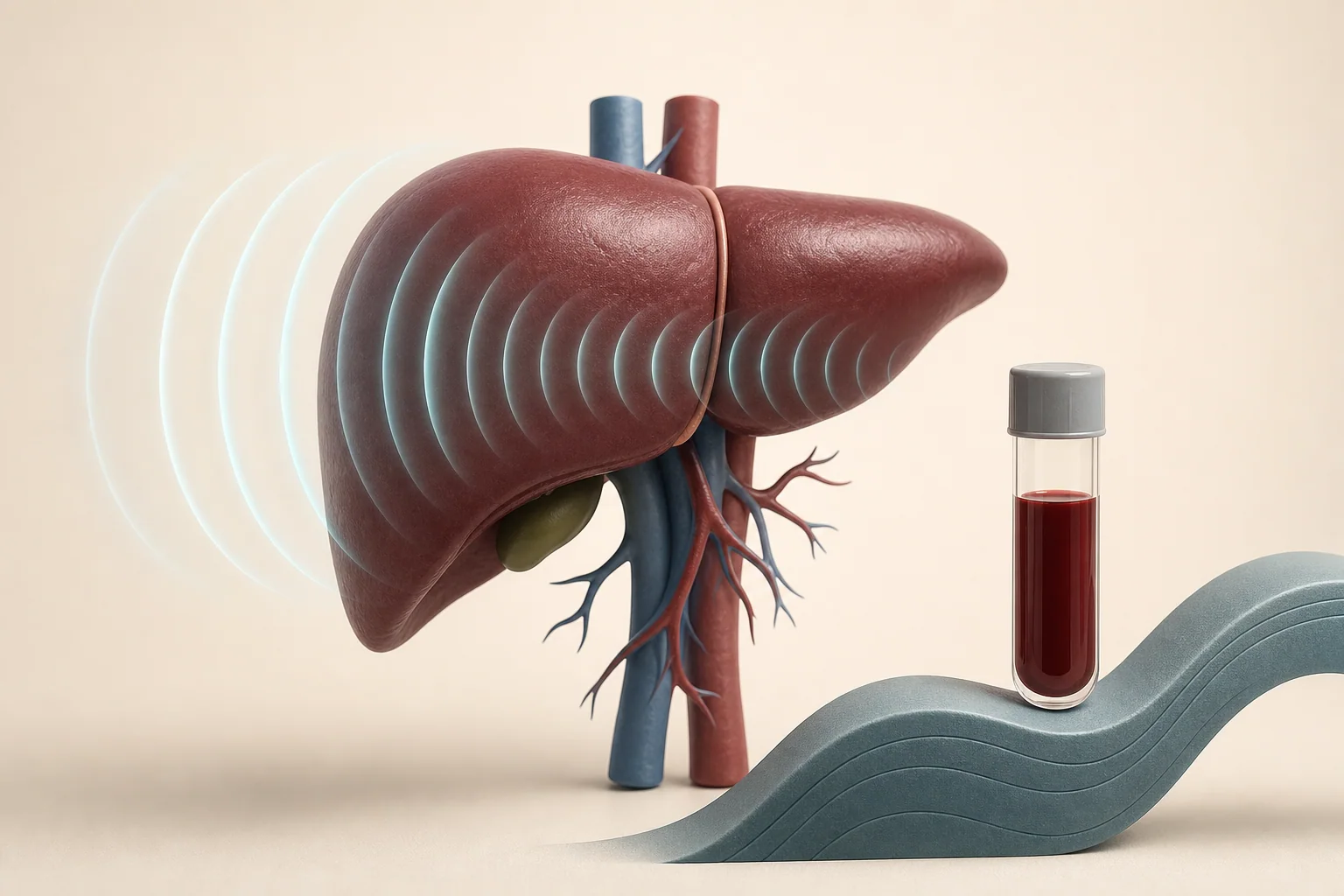
FIB-4 and FibroScan are two noninvasive methods that help estimate fibrosis, the amount of scar tissue that has formed in the liver. They are not the same test. FIB-4 is a score calculated from blood test results, while FibroScan is a type of elastography that measures liver stiffness.
They are mainly used to identify who is at low risk and who needs further assessment. This stepwise approach means that most people with fatty liver do not need a liver biopsy.
What is FIB-4?
FIB-4 combines four pieces of information that are often available from routine tests:
The result does not diagnose or rule out a disease on its own. It is a first-line filter. In adults with fatty liver, a low score is useful for ruling out advanced fibrosis. An intermediate score leaves uncertainty, while a high score raises concern.
Age affects the interpretation. Different thresholds are used in people over 65 because age increases the score even when liver disease has not worsened. The score may be less reliable in adults under 35. It should also not be calculated during acute hepatitis, when liver enzymes rise temporarily.
What is FibroScan?
FibroScan is the best-known brand of transient elastography. The device applies a gentle vibration through the skin and measures how quickly a wave travels through the liver. A stiffer liver generally has more fibrosis.
The procedure:
- Is painless and uses no needles or radiation.
- Usually takes less than 15 minutes.
- Is performed after fasting, according to the center’s instructions.
- Provides a liver stiffness measurement and, on many devices, an estimate of liver fat.
Stiffness can increase for reasons other than fibrosis, including acute inflammation, heart congestion, bile duct obstruction or a recent meal. The result must therefore be interpreted together with your medical history and blood tests.
How are the two tests used together?
For a person with fatty liver, the usual pathway is stepwise:
- FIB-4 is calculated from available test results.
- If risk is low, metabolic factors are treated and the score is repeated in the future.
- If the result is intermediate or high, elastography such as FibroScan or an equivalent test is obtained.
- If both tests suggest advanced fibrosis, or if their results disagree, specialist assessment is appropriate.
Thresholds vary with the underlying disease, age and measurement quality. A single number should not be interpreted using a table found online.
When is a biopsy needed?
Biopsy remains useful when the cause of liver injury is unclear, when noninvasive tests disagree or when identifying the exact type of inflammation could change treatment. It is not the first step for most patients.
How often should the tests be repeated?
Frequency depends on risk. A person with MASLD, type 2 diabetes or several metabolic risk factors usually needs reassessment at intervals, even if the first FIB-4 result was low. A result compatible with advanced fibrosis requires closer follow-up and assessment for possible complications of cirrhosis.
These tests do not replace medical care. Their main value is to organize the evaluation and identify early the smaller group of people who carry the greatest risk.
See also
References
- Sterling RK, Patel K, Duarte-Rojo A, et al. AASLD Practice Guideline on blood-based noninvasive liver disease assessment of hepatic fibrosis and steatosis. Hepatology. 2025;81(1):321-357.
- Sterling RK, Duarte-Rojo A, Patel K, et al. AASLD Practice Guideline on imaging-based noninvasive liver disease assessment of hepatic fibrosis and steatosis. Hepatology. 2025;81(2):672-724.
- European Association for the Study of the Liver, European Association for the Study of Diabetes, European Association for the Study of Obesity. EASL-EASD-EASO Clinical Practice Guidelines on the management of metabolic dysfunction-associated steatotic liver disease (MASLD). J Hepatol. 2024;81(3):492-542.
Related articles
Elevated liver enzymes: causes and evaluation
Elevated liver enzymes are common and do not always mean serious damage. Learn about their causes, diagnostic tests and signs requiring prompt care.
Hepatitis B tests: HBsAg, anti-HBs and anti-HBc
HBsAg, anti-HBs and anti-HBc distinguish hepatitis B infection, immunity and vaccination. Learn what the most common blood test patterns mean.

Bilirubin: what it is and what a high level means
High bilirubin can be due to hemolysis, Gilbert syndrome, bile duct obstruction or liver disease. How to interpret this test based on its pattern.